The Ancient Phonograph by Butler Shane;
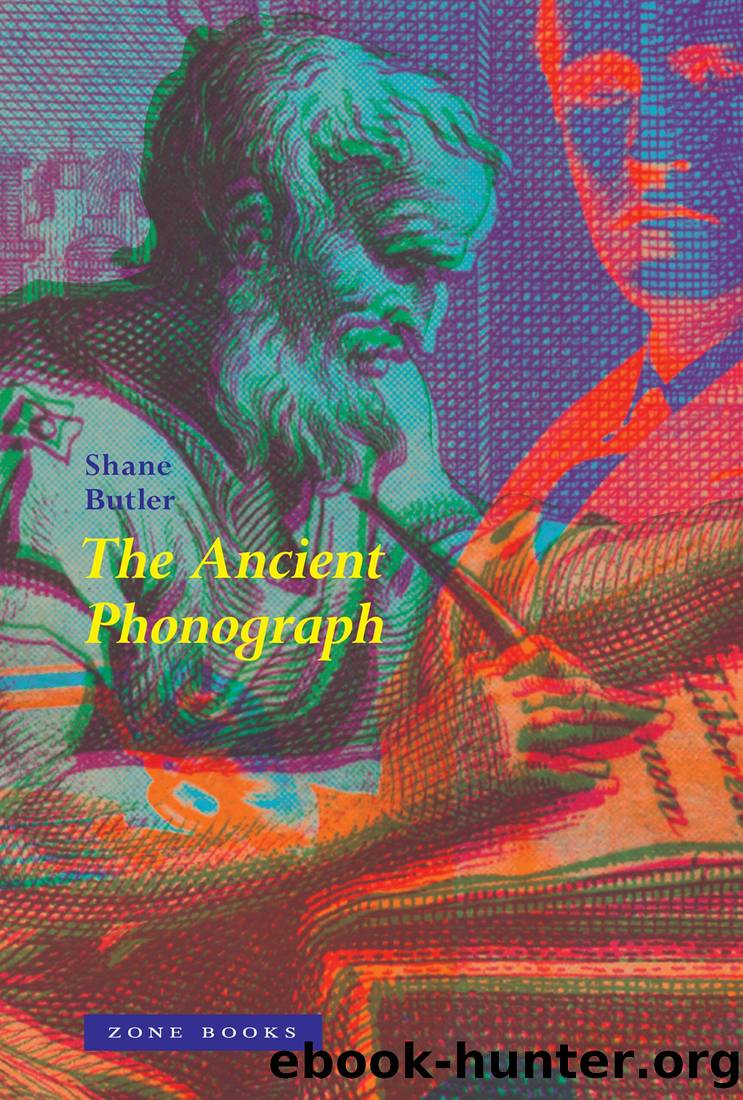
Author:Butler, Shane; [Butler, Shane;]
Language: eng
Format: epub
ISBN: 9781935408727
Publisher: MIT Press
Published: 2016-03-18T00:00:00+00:00
Track Five
Amazing Grace
Amazing grace! (how sweet the sound)
That savâd a wretch like me!
â John Newton, âAmazing Grace,â 1779
âWhat is this sound â so loud, so sweet â that fills my ears?â
â Cicero, âScipioâs Dream,â On The Republic 6.18
We shall approach antiquityâs most famous voice from a distance, beginning some fourteen centuries after the brutal dismemberment of the body to which that voice had once been attached. We are in Verona with Petrarch, in the summer of his fortieth year, surrounded by medieval towers perched atop the still hulking remains of the cityâs Roman past. We find him in the library (as we did Julius Pollux), among the dusty books of the cathedralâs chapter house. Here the scholar and poet uncovered at last the text that had eluded his meticulous searches throughout Europe: Marcus Tullius Ciceroâs collected letters to his friend and confidant, Titus Pomponius Atticus.1 The discovery would prove to be a watershed in literary history, not least because no other ancient text would exert as pervasive an influence on the Latin of the emerging movement we call the Renaissance.
When Petrarch had finished reading, he drafted a letter of complaint, addressed to none other than Cicero himself. Sometimes misread as genuine condemnation, the letter is instead full of tender irony, as the man who has been called the father of humanism pretends to reproach his most beloved author precisely for having been human. In the letterâs opening lines, this story of books and libraries yields to the language of living sound:
Francesco to his dear Cicero: Greetings. With enormous eagerness I have read through your letters, which I sought far and wide and found where I least expected to. I have heard (audivi) you saying (dicentem) many things, bemoaning (deplorantem) many things, changing many things, Marcus Tullius, and having long known the kind of teacher you were for others, I now realize who you were for yourself. In return, hear (audi), wherever you are, what I can no longer call advice but, rather, a lament (lamentum), born of true affection, which one of those who came after you, devoted to your glory, pours out not without tears.2
We often imagine that our texts âspeak,â and Petrarchâs language here underscores the vividness with which Ciceroâs intimate letters have just made their author present to their distant reader (and vice versa, given the conceit of a reply). Nevertheless, such noisiness would perhaps be more natural in response to Ciceroâs orations or dialogues, which pointedly invite us to hear him âsaying many thingsâ; a letter, by contrast, as its very name suggests, does not ordinarily pretend to be anything other than a written text.3 So, let us ask what exactly Petrarch thought he âheardâ in Ciceroâs letters, there in Verona in the summer of 1345.
For a first answer, we must briefly detour south, and back to 58 BCE, when, in March and April, Cicero traced an erratic path down the Italian peninsula. Along the way he dispatched a series of seven remarkable letters in
Download
This site does not store any files on its server. We only index and link to content provided by other sites. Please contact the content providers to delete copyright contents if any and email us, we'll remove relevant links or contents immediately.
The Great Music City by Andrea Baker(33957)
Aircraft Design of WWII: A Sketchbook by Lockheed Aircraft Corporation(32390)
Call Me by Your Name by André Aciman(20752)
The Secret History by Donna Tartt(19502)
The Art of Boudoir Photography: How to Create Stunning Photographs of Women by Christa Meola(18783)
Shoot Sexy by Ryan Armbrust(17870)
Plagued by Fire by Paul Hendrickson(17555)
Portrait Mastery in Black & White: Learn the Signature Style of a Legendary Photographer by Tim Kelly(17114)
Adobe Camera Raw For Digital Photographers Only by Rob Sheppard(17106)
Photographically Speaking: A Deeper Look at Creating Stronger Images (Eva Spring's Library) by David duChemin(16809)
Ready Player One by Cline Ernest(15169)
Pimp by Iceberg Slim(14815)
Bombshells: Glamour Girls of a Lifetime by Sullivan Steve(14240)
The Goal (Off-Campus #4) by Elle Kennedy(13990)
Art Nude Photography Explained: How to Photograph and Understand Great Art Nude Images by Simon Walden(13159)
Kathy Andrews Collection by Kathy Andrews(12120)
The Priory of the Orange Tree by Samantha Shannon(9387)
The remains of the day by Kazuo Ishiguro(9245)
Thirteen Reasons Why by Jay Asher(9151)
